




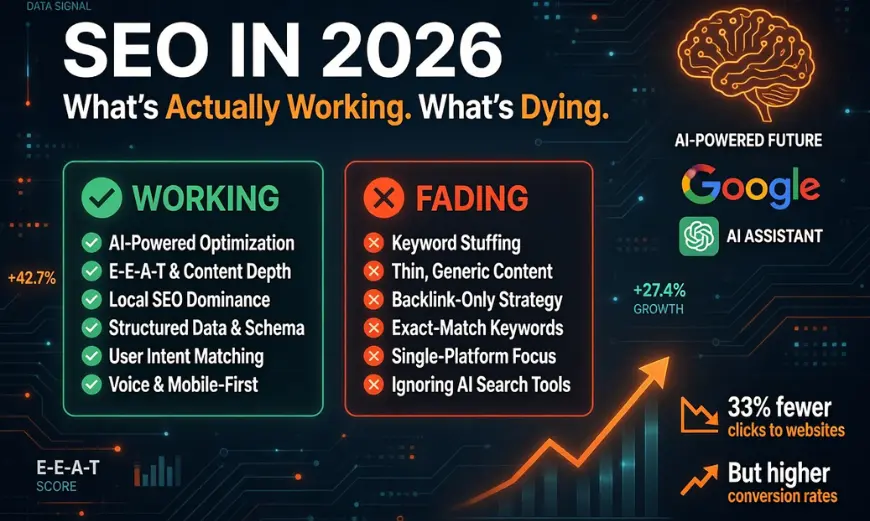
If you’re asking “Is SEO dead in 2026?” you’re asking the wrong question. The real question is how fast your business can adapt to what’s actually happening in search right now.
AI Overviews are sitting above the traditional blue links on most commercial searches. ChatGPT and Perplexity are becoming default research tools for a growing number of people. And according to SparkToro’s most recent 2026 analysis, less than a third of Google searches now send a click to any website at all, down sharply from where it stood even a year ago.
That sounds like the end of organic search. It isn’t. It’s a redistribution of where visibility comes from, and businesses that understand the shift are pulling ahead of the ones still debating whether SEO matters.
The Old Tactics Are Dead. SEO Isn’t.
Keyword stuffing, link farms, and doorway pages stopped working years ago, and that’s a good thing. Google’s algorithm updates systematically eliminated the shortcuts, which forced the industry to focus on what actually matters: helping real people find real answers.
Here’s the part that gets lost in “SEO is dead” headlines: when someone clicks through after seeing an AI Overview or a featured snippet that already told them you have the answer, they arrive at your site pre-qualified. Traffic volume may be down for purely informational queries, but the visitors who do click tend to convert at a higher rate, because Google, or the AI system, already vetted the relevance for them.
Why AI Search Actually Depends on SEO
AI systems don’t generate information from nothing. ChatGPT, Perplexity, and Google’s AI Overviews all synthesize content pulled from indexed web pages. If your business isn’t visible in traditional search, you won’t show up in AI-generated answers either, there’s no separate AI index to opt into.
Google’s own Search Central documentation confirms this directly, stating that AI Overviews and AI Mode rely on the same underlying index and ranking systems as regular search, and that there are no additional requirements or special optimizations needed beyond standard SEO fundamentals. In other words, ranking well in traditional search is still the foundation of showing up in AI-generated answers.
That’s why the smartest framing isn’t “SEO vs AI,” it’s SEO and GEO working together, each covering a different surface of the same search behavior.
Local businesses feel this most directly. When someone asks a voice assistant to “find a plumber near me who works weekends,” that answer is pulled from Google Business Profiles and local search data. No local SEO presence means no visibility in that answer, full stop.
What Actually Changed
|
Then |
Now |
|
Keywords repeated for ranking |
Topics and entities matter more than exact phrases |
|
Backlinks as the main authority signal |
Mentions, citations, and brand signals carry real weight |
|
Success measured by rankings |
Success measured by visibility across search, AI answers, and local results |
|
One search engine to optimize for |
Search happening across Google, ChatGPT, Reddit, TikTok, and voice assistants |
None of this makes SEO obsolete. It makes “just rank #1 on Google” an incomplete strategy.
What Small and Local Businesses Should Actually Do
Skip the doom framing and focus on what moves the needle:
Get the technical fundamentals right. Site speed, mobile usability, and clean structured data aren’t just ranking factors anymore, they’re what let AI systems accurately parse and cite your content. A slow, poorly structured site is invisible to both a human scrolling on their phone and an AI system trying to summarize an answer.
Treat your Google Business Profile as a primary asset, not an afterthought. For local businesses, this is often where AI assistants and the local map pack pull their answers from directly. An outdated or thin profile costs visibility that a great website can’t make up for.
Build FAQ and service content that mirrors how people actually ask questions. This is the same discipline that goes into content built to actually convert, not content built to fill a calendar. Structured, clearly answered questions get pulled into featured snippets and AI answers alike. Vague service descriptions that assume the reader already knows your industry get skipped over by both readers and AI systems.
Add real structured data (schema markup). This is one of the few technical moves that serves both goals at once: it helps Google generate rich snippets, and it gives AI systems clean, accurate information to extract when building an answer.
Don’t chase every platform at once. A generalist “search everywhere” strategy sounds appealing, but a local service business gets more from nailing local SEO and a handful of high-intent service pages than from spreading thin across TikTok, Reddit, and five other channels simultaneously.
How Long Does This Take to Show Results?
SEO timelines haven’t shifted dramatically just because AI entered the picture. Most businesses see early movement within 3-6 months and results that show up in leads and revenue within 6-12 months. Local SEO tends to move faster than national or highly competitive categories, simply because the competitive field is smaller.
Anyone promising page-one rankings in 30 days, AI-search visibility included, is selling something other than real SEO. If you’re weighing whether to handle this in-house or bring in outside help, it’s worth reviewing what small business SEO actually costs and how to evaluate an SEO company before committing to either path.
SEO Isn’t Dying. It’s Getting More Specific.
Every prediction that something would kill SEO has been wrong so far. Mobile search became mobile-first indexing. Voice search became conversational keyword optimization. AI search is becoming entity-based optimization and structured data, not the end of organic visibility.
The businesses actually struggling in 2026 are the ones ignoring SEO entirely, not the ones adapting their strategy to include local SEO, technical fundamentals, and AI-search visibility as one connected approach rather than three separate projects.
Curious where your business currently stands on both traditional and AI search? Get a free SEO and GEO audit from Wowbix.
FAQs
Is SEO dead or evolving in 2026?
Evolving, not dead. Old tactics like keyword stuffing and link farms stopped working years ago, but core SEO principles, technical performance, content quality, and matching search intent, remain essential. What’s changed is that SEO now also needs to account for AI Overviews, voice search, and how AI systems retrieve and cite content.
Is local SEO still relevant with AI taking over search?
More relevant than ever. AI assistants and voice search pull heavily from Google Business Profiles, local citations, and location-specific content when answering “near me” queries. A business without local SEO in place is invisible to that entire category of search.
Should small businesses still invest in SEO?
Yes, arguably more than before. AI widens the visibility gap between businesses that are properly optimized and those that aren’t. The businesses at risk are the ones sitting out entirely, not the ones adjusting their strategy.
How do I optimize for AI search tools like ChatGPT and Perplexity?
Focus on clear, well-structured content that directly answers specific questions, backed by proper schema markup and consistent business information across your site. AI systems favor content from sources that demonstrate real expertise, not generic, surface-level pages.
How long before SEO shows results?
Plan on 3-6 months for early movement and 6-12 months for results that show up in leads and revenue. Local SEO often moves faster since the competitive field is smaller.