





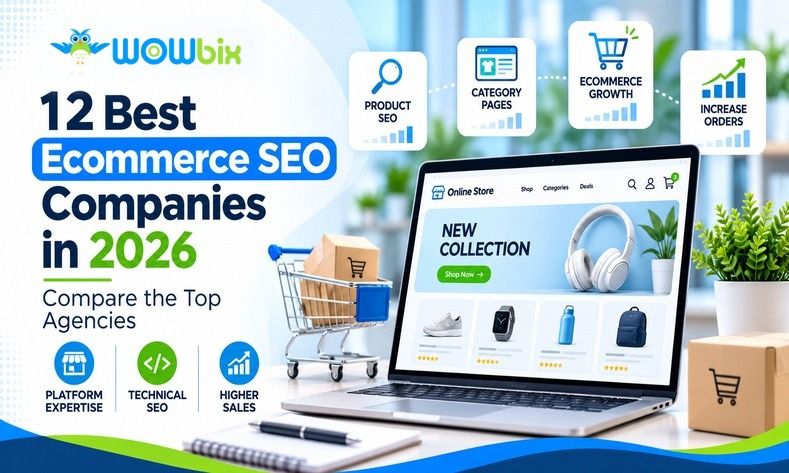
A store with 80 products and a store with 80,000 products do not need the same SEO agency. A small Shopify brand may need stronger collection pages. A large Adobe Commerce retailer may need help controlling filtered URLs, fixing product variants and protecting search traffic during a migration. Both can spend money on SEO without seeing more orders if the agency works on the wrong pages.
The best ecommerce SEO companies help stores become easier to find for the products shoppers want—and connect that visibility to purchases, not just traffic charts. Below are 12 agencies worth comparing, with a clear view of who each may suit, what their public evidence supports and what you should ask before signing.
Best Ecommerce SEO Companies at a Glance
On a phone? Scroll sideways to see all four columns.
| Agency | Best for | Platform / scope | Standout reason |
|---|---|---|---|
| Wowbix | Growing stores needing SEO + site help | WooCommerce projects documented; others advertised | SEO plus development |
| OuterBox | Large complex catalogs | Shopify, Magento, WooCommerce, BigCommerce | Technical SEO and ecommerce development |
| Inflow | Revenue-focused retail teams | Ecommerce SEO; specific platform proof to request | Organic revenue and CRO focus |
| 1Digital | Multi-platform and migrations | Shopify, BigCommerce, Adobe Commerce, WooCommerce | Platform-specific SEO and development |
| SmartSites | Integrated SEO + paid media | Ecommerce pages and multi-channel services | SEO with broader marketing |
| Searchbloom | Category and technical priorities | Shopify, WooCommerce services advertised | Commercial page emphasis |
| Coalition Technologies | SEO + CRO + development | Shopify, WooCommerce, Magento, BigCommerce | Implementation breadth |
| WebFX | Published ecommerce entry price | Ecommerce plans; request platform examples | Starting at $2,500/month |
| Victorious | Search and category discoverability | Ecommerce SEO; verify client-platform match | SEO specialist |
| StudioHawk | Specialist execution | Ecommerce technical and migration work | SEO-focused delivery |
| NOVOS | Retail digital PR + SEO | Retail brands; verify implementation needs | Ecommerce PR experience |
| Re:signal | International retail search | Multi-market retailer projects | Retail forecasting and search |
Use this as a starting shortlist. Platform support in a service description is not the same as a publicly documented project on that platform. Prices are discussed separately because most providers require a custom proposal.
How We Selected These Ecommerce SEO Agencies
We looked for a real ecommerce SEO offering, evidence of work on product or category pages, ability to address technical issues, relevant platform knowledge, examples of retail clients, and a credible way to measure orders or revenue. We also considered whether a provider combines SEO with website development, CRO, paid media or digital PR when that combination solves a specific retail problem.
The research came from current agency-owned service pages, public case studies and competing comparison articles. Public reviews and marketing claims were not converted into invented performance scores. The “best for” recommendations are editorial judgments based on demonstrated or advertised fit; a discovery call and sample project plan are still necessary.
The 12 Ecommerce SEO Companies Worth Comparing
1. Wowbix — Best for Growing Stores That Need SEO and Website Development
Best for: smaller and midsize online businesses that need technical SEO, product/category improvements and hands-on website support coordinated by one team.
Wowbix combines search optimization, WordPress development, ecommerce implementation, content planning and ongoing website support. Its SEO service page explicitly describes Shopify, WooCommerce, Magento and custom platform services, including product-page optimization and structured data. The strongest published ecommerce implementation evidence is in WordPress and WooCommerce.
The Nouri Brothers project describes a WooCommerce storefront, product catalog and ordering features alongside SEO and maintenance. The case study reports growth from about 100 monthly site visitors in 2016 to more than 15,000; that 14,900% figure describes overall website visits, not verified organic revenue growth. Mind Your Skin documents adding WooCommerce to an existing site and optimizing product and service pages. A separate Contact Lens Marketplace case study covers an ecommerce catalog, filtering, checkout and search-oriented category structure.
What stands out: evidence of working across site build, catalog structure and ongoing SEO instead of only providing keyword recommendations.
Pricing: custom ecommerce SEO quote; do not confuse the general SEO page’s starting rate with a confirmed ecommerce-specific package.
What to consider: request directly comparable Shopify or Magento project evidence if you use those platforms, and ask who will make technical changes.
Website: Visit official services | Relevant projects: Nouri Brothers case study ; Mind Your Skin case study ; Contact Lens Marketplace project
WOWBIX ECOMMERCE SEO
Find the SEO gaps costing your store sales.
Discuss category pages, technical issues and the changes most likely to support qualified orders.
2. OuterBox — Best for Large Catalogs and Developer-Backed Technical SEO
Best for: retailers facing large catalogs, messy category structures, migrations or complicated templates.
OuterBox has a dedicated ecommerce SEO practice and describes support for Shopify and Shopify Plus, Magento/Adobe Commerce, WooCommerce, BigCommerce and custom builds. Its work spans category architecture, product content, technical SEO, design, CRO and paid media. The breadth matters when a catalog needs changes to site templates and filters, not dozens of isolated text edits.
What stands out: a defined ecommerce and development offering with platform-specific service material.
Evidence: its dedicated ecommerce service page and case-study library.
Pricing: request a current scope-based quote.
What to consider: ask whether the agency will actually implement code changes on your platform, whether development hours are included, and how it will control crawlable filter combinations without hiding valuable search pages.
Website: Visit official services
3. Inflow — Best for Retail Teams Focused on Organic Revenue
Best for: ecommerce businesses with an existing marketing operation that want SEO tied more closely to transactions and overall acquisition costs.
Inflow positions itself as an ecommerce marketing agency. Its SEO offering includes technical audits, content work, link development, migration assistance and analytics. Adjacent services include paid search, CRO, GA4 and reporting, which makes it a possible fit for retailers trying to explain why organic visits rose while sales stayed flat.
What stands out: unusually explicit attention to conversion and measurement around ecommerce SEO.
Evidence: its ecommerce SEO service and case-study pages.
Pricing: custom proposal.
What to consider: verify direct experience with your exact platform and confirm how it separates branded organic revenue, new customers and SEO-assisted purchases; do not assume a published service menu means all implementation work is included.
Website: Visit official services
4. 1Digital Agency — Best for Multi-Platform Stores and Replatforming
Best for: merchants operating Shopify, BigCommerce, Adobe Commerce/Magento, WooCommerce or headless systems who want agency coordination with developers.
1Digital explicitly markets ecommerce SEO across those platforms and discusses product-detail pages, category architecture, technical fixes, migration planning and development collaboration. It also offers design and development services. This can be useful when a retailer has to move from Magento to Shopify or correct template issues that an SEO consultant cannot deploy alone.
What stands out: platform-specific positioning paired with an implementation-oriented team.
Evidence: its ecommerce SEO page, platform information and published client material.
Pricing: request an ecommerce proposal.
What to consider: ask for a migration example on the same source and destination platforms, a redirect-mapping process, product variant handling and the approval workflow for code deployments.
Website: Visit official services
5. SmartSites — Best for Ecommerce SEO With Paid Media Support
Best for: online stores that need organic improvements but also run paid acquisition, product ads or a broader digital marketing program.
SmartSites publicly offers ecommerce SEO covering keyword mapping, product-page improvements, URL structure, on-page optimization and link work. Its broader services include advertising and website marketing. A coordinated search plan can be helpful when product categories have different profit margins or seasonal demand.
What stands out: integrated marketing services around an ecommerce SEO offering.
Evidence: dedicated ecommerce SEO page and agency case-study resources.
Pricing: custom quote for a comparable ecommerce scope.
What to consider: request a product-category case study, ask whether Merchant Center feeds and paid shopping campaigns are part of the contract, and insist that paid and organic revenue be reported separately.
Website: Visit official services
6. Searchbloom — Best for Technical Prioritization and Category-Level Growth
Best for: retailers that want a structured SEO program targeting commercially valuable category and product searches.
Searchbloom’s ecommerce SEO page emphasizes large catalog optimization, technical work, action prioritization and revenue-driven execution. It also maintains dedicated Shopify and WooCommerce services alongside development, analytics and CRO offerings. Those service areas match the needs of a store where category templates or navigation are holding back discovery.
What stands out: explicit prioritization of commercial pages and catalog-scale optimization.
Evidence: current ecommerce service page and public case-study library.
Pricing: custom.
What to consider: ask for examples of category-query mapping and filter rules, how its team coordinates changes with your developer, and what progress will be expected before the first large content expansion.
Website: Visit official services
7. Coalition Technologies — Best for SEO, Ecommerce Development and CRO Together
Best for: stores whose organic growth depends on technical changes, product merchandising, mobile experience and conversion improvements as well as content.
Coalition Technologies has ecommerce SEO services, storefront design/development and conversion optimization. Its site lists work across Shopify, WooCommerce, Magento and BigCommerce and links to ecommerce case studies, including a jewelry-related revenue example. Those are agency-published outcomes; buyers should obtain the actual baseline, timeline and channel attribution before using them to forecast a new project.
What stands out: close pairing of ecommerce website work with SEO.
Evidence: dedicated service page and named project summaries.
Pricing: custom quote; a general package or directory estimate is not a verified ecommerce commitment.
What to consider: confirm what part of template code, content production, CRO tests and QA is included in the retainer, and whether design changes would require a separate statement of work.
Website: Visit official services
8. WebFX — Best for Published Ecommerce SEO Starting Pricing
Best for: ecommerce teams that want full-service search support with a visible starting budget and centralized reporting.
WebFX’s ecommerce SEO service page includes an audit, ongoing optimization, content for product pages, marketplace-related support and revenue reporting. It publishes a starting rate of $2,500 per month for custom ecommerce SEO plans. The scope varies with catalog size, content production and partnership needs; the advertised starting rate is not a fixed price for every store.
What stands out: published ecommerce-specific entry pricing and a broad team.
Evidence: the agency’s ecommerce service and pricing pages.
What to consider: request the exact package line items, software fees, development and content limits, what reporting attributes to organic ecommerce, and whether platform-specific technical changes are performed or merely recommended.
Website: Visit official services | Published plans: Published pricing
9. Victorious — Best for Product Discovery and SEO Content
Best for: consumer brands seeking stronger category and product visibility alongside SEO content and authority development.
Victorious offers ecommerce SEO and separately advertises technical SEO, audits, migrations, content and link building. Its ecommerce page focuses on getting product pages discovered and improving commercially relevant organic traffic. Its website identifies platform service areas including WooCommerce, Magento and BigCommerce, but the buyer still needs to establish a successful project on the relevant store platform.
What stands out: a search-specialist approach rather than a general website redesign pitch.
Evidence: ecommerce service page, client logos and case-study materials published by the agency.
Pricing: custom.
What to consider: ask how it handles category templates, seasonal product turnover and developer ticket implementation; verify whether a separate engineering partner is required.
Website: Visit official services
10. StudioHawk — Best for Specialist Ecommerce SEO Execution
Best for: retailers that want a specialist SEO team focused on commercial intent, technical priorities and sustained improvements.
StudioHawk positions itself as an SEO specialist with dedicated ecommerce, technical SEO, migration, content and digital PR services. Its ecommerce offering emphasizes practical work over traffic for its own sake. This can suit teams with internal developers who want detailed SEO direction and consistent collaboration.
What stands out: specialist search focus with separate technical and migration capabilities.
Evidence: ecommerce service page and public project material.
Pricing: custom quote.
What to consider: verify project examples on the exact platform and in the U.S. market, the time-zone and communication model, and who deploys code changes if your team cannot.
Website: Visit official services
11. NOVOS — Best for Retail SEO Paired With Digital PR
Best for: established DTC and retail brands that need stronger nonbranded discovery, editorial authority and category visibility across multiple markets.
NOVOS is an ecommerce-focused growth agency offering SEO, digital PR, paid media and AI-search-related work. Its website presents named retailer projects including Ruggable and Osprey, along with detailed retail work. For a brand whose product pages are structurally sound but whose authority and category presence are weak, that combination could be useful.
What stands out: ecommerce-specialist positioning and visible retailer work, particularly digital PR connected to commercial pages.
Evidence: named case-study library on the official site.
Pricing: custom proposal.
What to consider: ask about U.S. category experience, collaboration across time zones, and whether the team itself handles deep platform fixes or coordinates with your developers.
Website: Visit official services
12. Re:signal — Best for Established Retailers With International Search Needs
Best for: larger ecommerce brands operating across countries, channels and retail search platforms.
Re:signal centers its work on ecommerce growth and forecasting. The agency publicly describes technical SEO, content, digital PR, retail search, product-data work and an emphasis on organic revenue. Its site names large retail brands including Under Armour, ASICS and JD, although a logo alone should not be treated as a detailed case study or a guarantee of performance.
What stands out: retail-search perspective beyond a conventional SEO checklist and an explicit revenue-forecasting focus.
Evidence: official ecommerce positioning, client references and published work.
Pricing: custom.
What to consider: request examples in your countries, languages and platform, confirm how forecasts are constructed, and clarify responsibility for translation, feeds and developer changes.
Website: Visit official services
Which Ecommerce SEO Agency Fits Your Store?
A small Shopify brand with a few high-margin collections should prioritize evidence of improving collection and product pages, not an enterprise crawl-budget presentation. Ask for a plan for one real collection and a product-detail page. Compare specialist SEO execution with a lean full-service partner such as Wowbix when website work also needs attention.
A WooCommerce store should prioritize WordPress knowledge, indexing controls, template performance and reliable plugin changes. Wowbix’s published WooCommerce projects provide direct implementation evidence; providers including OuterBox, Searchbloom, 1Digital and Coalition also advertise WooCommerce-related capabilities.
A large Magento/Adobe Commerce or headless store should ask for tested architecture, variant and filter decisions, developer collaboration and a migration playbook. Compare OuterBox and 1Digital with any agency that can show work on your exact version, integration stack and SKU scale.
A DTC brand with healthy traffic but poor sales needs organic revenue diagnostics and CRO collaboration. Inflow, Coalition and WebFX advertise relevant combinations. A multinational retailer should compare specialist support for multilingual content, international inventory, regional search and merchant feeds; Re:signal, NOVOS and qualified enterprise providers deserve investigation.
These are starting-fit judgments, not exclusive assignments. The right agency still depends on the actual pages, budget and team you have.
What Should an Ecommerce SEO Company Actually Do?
Technical store SEO: check crawlable catalog navigation, indexation, canonicals, product variants, filtered URLs, duplicate or retired product pages, internal links and site performance. Google explains that category-to-product links help it understand site structure, and that unrestricted faceted parameters can create a large number of crawlable URLs. See Google’s faceted navigation guidance for crawler recommendations.
Commercial keyword strategy: match search intent to the correct page. “Running shoes for flat feet” may suit a collection page; an exact model query may belong on a product page. Publishing blog posts for every product term can compete with the pages that should sell the products.
Product and category optimization: improve descriptions, titles, on-page information, accessible links, useful comparison details and merchandising content. For large stores, the agency should describe how it will improve templates and priority categories rather than manually editing every SKU without a scalable system.
Product information and structured data: keep price, availability, variants and other eligible details accurate. Google’s product structured data and Merchant Center feeds can complement one another, but structured data is not a guarantee of rich results and a product feed is not a substitute for crawlable site pages. Review Google’s merchant listing requirements when checking eligible product markup.
Content and authority: publish helpful buyer guides and comparisons where they address real questions, then earn relevant references through legitimate outreach or digital PR. Ask which content supports high-value categories rather than funding an unrelated article calendar.
Revenue measurement: connect Google Search Console with available analytics, catalog and transaction data. Review organic orders, attributed sales, new customers, conversion rates, average order value and, when available, contribution margin. GA4 attribution is not a complete accounting ledger; returns, consent, cross-device activity and assisted conversions complicate the picture.
Implementation and QA: a strategy deck is not a technical fix. Confirm who modifies templates, approves redirect maps, verifies Product markup, checks staging and validates that changes did not break the store or checkout.
How Much Do Ecommerce SEO Companies Charge?
There is no one price that represents all ecommerce SEO engagements. Scope changes dramatically with platform, number of products, number of templates, migration work, international markets and developer availability.
One transparent reference is WebFX’s ecommerce SEO service page, which advertises custom plans starting at $2,500 per month. Its separate pricing research describes wider spending ranges collected from surveyed U.S. professionals; those are reported market observations, not what every agency on this list charges. Most other providers in this guide require a custom ecommerce quote. A general SEO starting price should not be passed off as a confirmed ecommerce retainer.
Retainers may cover ongoing strategy, technical recommendations, on-page changes, content and reporting. A one-time technical audit may identify problems without fixing them. Migrations can require separate redirect planning, staging QA and deployment support. Product content at scale and ecommerce development may be billed separately. Ask for a total first-year budget, not just the lowest advertised monthly fee.
Example: two agencies quote the same $3,000/month. One includes developer implementation, 10 prioritized category-page revisions and analytics QA. The other includes recommendations but expects your staff to handle development. Those proposals may have very different real costs. This is an illustration, not a published package from either provider.
How to Choose the Right Ecommerce SEO Agency
Step 1: Name the Actual Constraint
Is your problem a category that never ranks, a surge in duplicated filter pages, falling organic orders after a migration, or traffic that does not convert? Bring the three most important examples to discovery calls. Agencies should respond to your actual store, not only describe a standard campaign.
Step 2: Demand Platform-Specific Proof
Ask for recent work on the same platform, ideally at a similar catalog scale. A Shopify Plus enterprise migration is different from a new WooCommerce store. A claimed platform badge is a starting point, not proof of a completed engagement.
Step 3: Inspect Case Studies Like a Buyer
Look for the starting problem, dates, work performed, search-channel measurement and impact on orders or revenue. If a case study says traffic rose 200%, ask whether that was organic search, all channels or a seasonal spike. An agency-published case is useful evidence, but it is not an independent financial audit.
Step 4: Identify Who Implements and Tests
Will the agency change code, open tickets for your developers or only provide a recommendations document? Who owns staging, version control, launch approvals and QA? Get this answered before a technical audit uncovers work nobody is assigned to complete.
Step 5: Require a Comparable 90-Day Plan
Ask each shortlisted agency for priority pages, expected deliverables, technical and content work, review meetings, reporting definitions and decision gates. Compare like for like. A proposal that promises “more keywords” without identifying catalog problems is hard to evaluate.
Step 6: Clarify Measurement and Contract Terms
Confirm GA4, Search Console and ecommerce tracking access; distinguish gross revenue from net sales and margin; and document how canceled and returned orders are handled. Check minimum term, price increases, cancellation notice, access to work, ownership of content and the handover process if you change providers.
Questions to Ask Before Hiring
- Which stores have you worked on using our ecommerce platform, and can you show relevant examples?
- How do you determine whether collection, category or product-detail pages should target a search term?
- How will you assess filters, variants, product availability, pagination, indexing and canonical rules?
- Which recommendations will your team implement, and which will our developers need to deploy?
- What is the plan for our most important categories in the first 30, 60 and 90 days?
- Can you show a case study that separates organic ecommerce orders and revenue from all-site traffic?
- How will you report branded versus nonbranded visibility and deal with returns or attribution limits?
- What work is excluded from the retainer—development, content production, PR, feeds or migration QA?
- Who owns our SEO documentation, analytics properties, content and technical fixes if we cancel?
- If organic traffic improves but profitable orders do not, how will you change the strategy?
What Should the First 90 Days Look Like?
Days 1–30: audit important commercial pages, Search Console and analytics; review crawl/indexing patterns, product variants, filters, technical debt and competitors; identify high-value category targets; agree on goals and responsibilities.
Days 31–60: fix the highest-impact issues that can be implemented safely; improve priority category and product templates; strengthen internal links; confirm structured data and product-data consistency where appropriate; begin approved content or authority initiatives.
Days 61–90: validate deployed changes, recrawl key templates, review search and order data, adjust category priorities and produce the next-quarter plan. This is a useful example workflow, not a guarantee that every agency or website will finish the same work on the same schedule.
Warning Signs in an Ecommerce SEO Proposal
Guaranteed rankings, guaranteed AI shopping mentions or promised revenue without access to your store’s data should raise concern. So should case studies with no date or baseline, an agency claiming expertise on your platform without examples, and a campaign that ignores your category structure and technical constraints.
Other warning signs include invoices with unclear implementation scope, no assigned developer or technical owner, an obsession with traffic to articles that never lead to purchases, and contracts that do not explain what happens to the site or accounts when you leave. Ask for explicit deliverables and a sample report rather than relying on promises.
Agency, Freelancer or In-House SEO: Which Model Works?
An agency can cover technical strategy, content, digital PR, analytics and development coordination with multiple specialists. That breadth costs more and requires a clear account team. A freelancer may be efficient for a narrowly scoped audit, Shopify content plan or consulting engagement, but a complex migration may exceed one person’s capacity. An in-house specialist builds deep product knowledge and works closely with merchandising and engineering, yet may still need outside help for specialized audits or PR.
For a lean store, a capable freelancer plus a reliable developer can work well. For a growing brand with several SEO workstreams, an agency may be easier to scale. For a major retailer, an in-house owner supported by outside specialists often reduces handoff problems. Decide based on responsibilities and skill coverage, not the title on the contract.
Frequently Asked Questions
What is the best ecommerce SEO company?
The best choice depends on the store. Wowbix is worth considering for SEO combined with WooCommerce and website support. OuterBox and 1Digital warrant comparison for more complex platforms; Inflow and Re:signal are relevant when commercial measurement and retail search strategy are central. Request evidence that matches your needs.
Is Shopify SEO different from WooCommerce or Magento SEO?
The fundamentals overlap, but platform templates, app or plugin behavior, filtering, URL structures and developer workflows differ. Ask for evidence on your actual platform and store configuration.
How long does ecommerce SEO take?
There is no universal timeline. A small on-page correction may be visible quickly; rebuilding category architecture and recovering after a migration may require more time. Demand milestones for completed work and measured progress rather than an exact ranking date.
Can an ecommerce SEO agency increase online sales?
It can improve discoverability, relevance and conversion paths, but results depend on products, prices, inventory, demand, competition and the buying experience. An agency should explain how it measures incremental ecommerce value.
Do I need a Shopify SEO agency specifically?
Not necessarily. A competent broader ecommerce team may be appropriate, but it should demonstrate how it handles Shopify collections, product variants, navigation and platform limitations. Platform-specific experience matters more than a label.
What should an ecommerce SEO report include?
At minimum: meaningful changes completed; priority category and product search performance; relevant nonbranded traffic; orders and attributed revenue with caveats; and next steps. If margins are available, add contribution-based measures.
Should an ecommerce business hire an agency or freelancer?
Choose based on the work. A targeted content or audit project may suit a specialist freelancer; a store-wide technical, content, development and PR program may need a multi-person team. Confirm who implements and validates changes in either model.
Final Thoughts: Choose an Agency That Can Work on Your Store
WOWBIX ECOMMERCE SEO
Ready to improve your ecommerce visibility?
Share your store platform, priority products and growth goals for a focused SEO conversation.
A strong ecommerce SEO partner understands your catalog, the system behind it and the business value of the pages shoppers reach. The right agency should show relevant work, explain its implementation plan, measure orders rather than just visits, and make contract responsibilities clear.
If your store needs better product visibility, cleaner category architecture or help diagnosing technical SEO issues, talk with Wowbix about your ecommerce SEO priorities. Start with our SEO services page: Wowbix SEO services.