




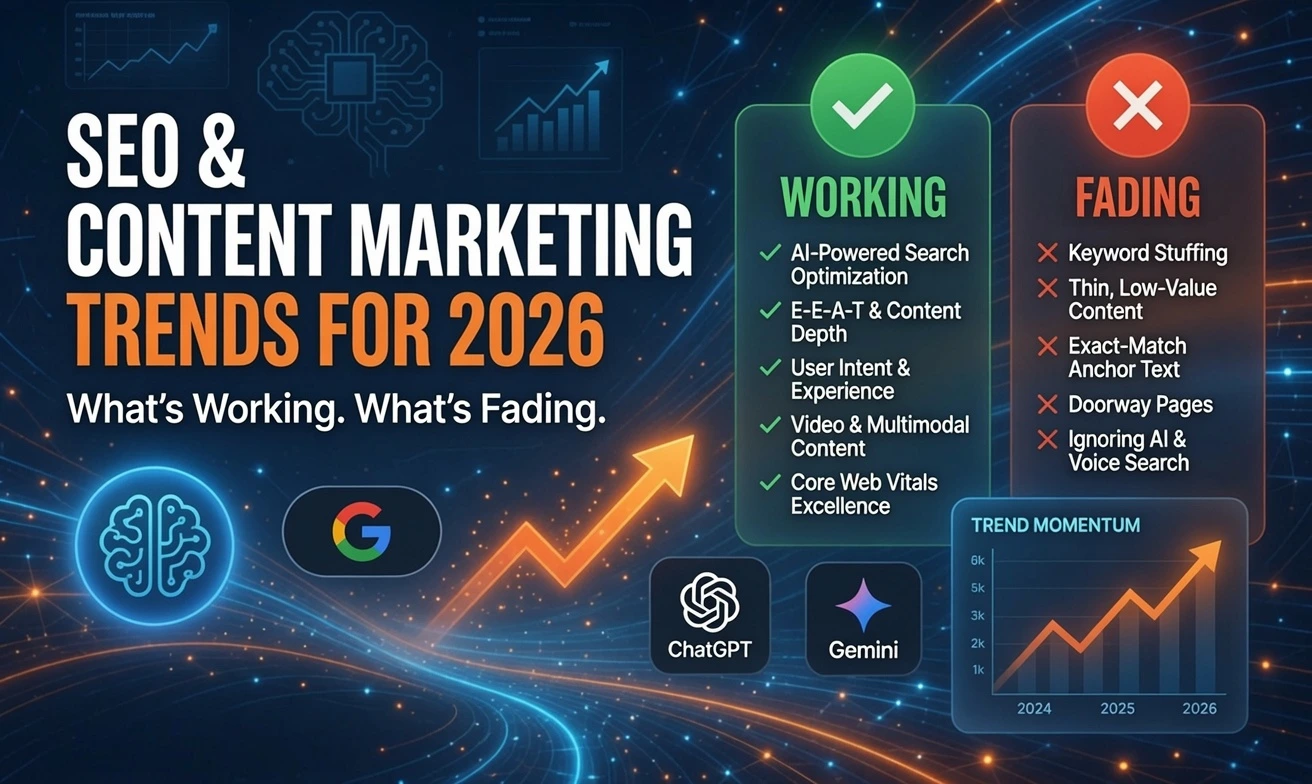
If you’ve been following SEO for any length of time, you already know the rules keep changing. But 2026 isn’t just another update cycle — it’s a more fundamental shift in how visibility, trust, and traffic actually work together.
Search and content are no longer separate strategies. They’ve merged into a single system where your brand needs to show up across classic Google rankings, AI-generated answers, video results, and community-driven platforms — all at once. Teams that adapt to this reality are pulling ahead. Teams still running 2022 playbooks are quietly losing ground.
Here’s what’s actually working right now, what’s fading out, and what to do about it.
1. AI Is Part of Every Workflow — But Process Beats Tool Choice
Nearly every marketing team is using AI in some capacity now. The gap isn’t between teams using AI and teams that aren’t — it’s between teams with a clear, quality-controlled process and teams that treat AI as a shortcut to publishing more.
The problem with volume-first AI publishing is that Google has seen it too. Since the AI content explosion of 2023, Google has aggressively updated its algorithm to surface genuinely helpful, experience-backed content — and demote content that reads like it was generated, published, and forgotten.
What’s working: Using AI for speed, structure, gap analysis, and outlining — then applying human judgment to everything that affects trust. Claims, examples, original takes, and brand voice all still need a real person behind them.
What’s fading: Fully automated content pipelines with no editorial oversight. These look efficient until your traffic tanks after a core update.
2. E-E-A-T Is No Longer Just a Guideline — It’s a Growth Constraint
Google’s E-E-A-T framework (Experience, Expertise, Authoritativeness, Trustworthiness) has been talked about for years, but in 2026 it’s functioning as a hard ceiling on growth for many sites.
Good writing isn’t enough anymore. You need visible proof behind the content — real authorship, demonstrated experience, and third-party validation that your brand is the real deal. This is especially true in competitive markets and any space that touches health, finance, legal, or professional services.
What’s working:
- Author bios that show genuine credentials and real names
- Original research, case studies, and first-hand data
- Third-party mentions through digital PR, podcasts, and industry coverage
- “Proof blocks” on key pages that explain who wrote it, why they’re qualified, and what sources were used
What’s fading: Anonymous content, generic “expert” bylines with no verifiable background, and pages that make claims without any supporting evidence.
This is why at Wowbix, our content marketing approach focuses on building real authority for clients — not just publishing content that fills space.
3. Zero-Click Is Rising, But Brand Recognition Still Wins
More searches than ever end without a click. AI Overviews answer the question directly. Featured snippets give the answer before the user even sees your site. This makes a lot of marketers nervous, and understandably so.
But here’s the more useful framing: if someone sees your brand name in an AI answer, a featured snippet, or a knowledge panel — and then later searches for you by name — that’s still a win. Brand recognition is becoming its own performance metric.
What’s working: Tracking visibility outcomes beyond traffic — branded search growth, direct visits, and conversions that were influenced by content even if they didn’t click on that specific post.
What’s fading: Measuring SEO success purely by pageviews and session counts. The attribution landscape is messier now, and teams that don’t adapt their measurement will undervalue what’s actually working.
4. “Publish More” Is Dead — Fewer, Better Pages Win
This is one of the biggest strategic shifts happening right now, and many businesses are still on the wrong side of it.
For years, the conventional content wisdom was to publish as much as possible and let volume do the work. That approach is now actively working against sites that pursued it. Thin content, redundant pages, and generic articles that don’t say anything new are dragging down overall site quality — and Google’s core updates have been penalizing this pattern.
What’s working:
- Topic clusters built around real user intent — a strong core page, supporting pages, and proof assets
- “Flagship” content that goes deep on a topic and earns links and citations over time
- Pruning or consolidating old content that isn’t ranking and isn’t helping users
What’s fading: The “just keep publishing” approach. More pages isn’t a strategy. More useful pages is.
If your blog has dozens of posts sitting on page four of Google and getting zero organic traffic, that’s not a backlink problem — it’s a content quality and strategy problem. Our SEO audit service typically uncovers exactly this issue for businesses that have been publishing without a clear architecture.
5. Blogs Still Work — But They Need to Do More
Blog content isn’t dying. It’s still one of the highest-ROI formats available, and marketers continue to invest in it. But a text-only article published and left alone is increasingly at a disadvantage compared to content that includes visuals, video, interactive elements, and strong internal linking.
The shift is from blog post as isolated article to blog post as content hub.
What’s working:
- Blog posts that include summary sections, visuals, and links to supporting pages
- Repurposing: one strong blog post becomes a LinkedIn thread, a short video, a social post, and a downloadable resource
- Strong internal linking that connects the post to relevant service pages and other articles
What’s fading: Publishing a post, sharing it once on social, and calling it done.
This connects directly to why local SEO and content have to work together — a well-written local article that links to your core service pages does double duty for both rankings and user experience.
6. AI Search Means Your Content Needs to Show Up in New Places
This is the trend that’s reshaping SEO strategy fastest in 2026. When someone asks ChatGPT, Google Gemini, Perplexity, or Microsoft Copilot a question related to your business — are you showing up in the answer?
If your content isn’t structured to be cited by AI systems, you’re invisible to a growing segment of searchers who never touch a traditional search results page.
This is what Generative Engine Optimization (GEO) addresses — and it’s a meaningful shift from traditional SEO. It’s not about meta tags and keywords alone; it’s about building the kind of credible, well-structured, authoritatively cited content that AI systems draw from when generating answers.
Wowbix’s GEO services are specifically designed to help businesses get recommended by these AI platforms — so your brand shows up whether a prospect is searching on Google or asking an AI assistant.
7. Trust Ecosystems Beat Isolated Content
The most useful mental model for 2026 content strategy isn’t “what should I publish next?” It’s “what does my connected body of work say about my brand’s credibility?”
A single great article helps. A network of well-linked, mutually reinforcing content — case studies, expert posts, third-party mentions, original data — builds the kind of trust signal that compounds over time.
What’s working:
- Publishing content that demonstrates real access and experience: client case studies, industry teardowns, practitioner interviews
- Linking assets together intentionally so users (and search engines) can navigate a coherent body of work
- Earning external mentions through digital PR, partnerships, and contributing to industry publications
What’s fading: Isolated content that exists on its own island with no external validation and no internal support.
This is why our case studies page is one of the most important parts of our site — it’s proof, not just claims.
8. Budgets Are Holding, But Results Matter More Than Ever
Marketing budgets for SEO and content have remained stable heading into 2026, but internal scrutiny is higher. Leadership wants clearer answers on what content is actually contributing to pipeline and revenue.
This is actually good news for teams doing strategic work. When the question is “what did this content do for the business?” — quality-focused, intent-matched content has a much better answer than a high-volume publishing calendar built around thin topics.
What’s working: Tying content to real commercial outcomes — leads generated, qualified traffic to service pages, sales conversations influenced by a specific article.
What’s fading: Reporting on publishing volume and traffic without connecting either to business results.
The 2026 Playbook in Plain Terms
If you want to simplify everything above into an operating framework:
Pick 3 to 5 topics you genuinely want to own — not 30. Build deep, credible, well-linked content around each. Add proof at every level: who wrote it, why they know this, and what evidence backs it up. Distribute intentionally across formats. Measure what matters to your business, not just traffic. Prune regularly so your site stays focused and coherent.
That’s it. The businesses winning in search right now aren’t doing 50 things — they’re doing 5 things well and consistently.
Ready to Build a 2026 Content Strategy That Actually Performs?
If you’re not sure where your current content and SEO stand, the best place to start is a real audit — not a generic checklist, but a look at your specific site, your competition, and where the real opportunities are.
Get a free growth audit from Wowbix and we’ll tell you exactly what’s working, what isn’t, and what a realistic 2026 content strategy looks like for your business.