





I get asked some version of this question almost every week now, usually by a business owner who just watched a demo of some AI tool that promises to “automate their SEO.” Will AI replace SEO professionals? Can AI just do this now? Do I still need to pay someone?
Short answer: not really, no. Longer answer takes a bit more explaining, and honestly it’s worth explaining properly because I’ve watched a handful of clients learn this the expensive way over the past year.
Here’s what actually happened with one of them. A local practice came to us in early 2026 after six months of running an AI content tool on their own. They’d published almost 40 posts. Traffic had barely moved, and two of their older, thinner pages had actually dropped out of the index entirely. Nothing was technically wrong with the writing. Grammar was fine, keywords were in there. It just didn’t say anything a competitor’s page didn’t already say, in roughly the same way.
That’s the part AI still doesn’t solve on its own.
Where AI Actually Falls Short in SEO
I’m not anti-AI, to be clear. I use it daily. My team uses it daily too. Pretending otherwise would be a little dishonest, given how the industry works right now.
But there’s a real ceiling. I keep running into the same three walls with clients.
1. It writes content, not a plan
Ask a tool to draft “signs you need a new water heater” and you’ll get something readable in under a minute.
What it won’t know is smaller stuff that actually matters. Maybe this client’s last dozen service calls were all older homes with the same brand of tank failing early. That’s a detail worth building the whole angle around. A tool has no way to know that. A plan comes from someone actually looking at the business, not just the topic.
That’s the real difference. A page that exists versus one that’s part of an actual content strategy.
2. It flattens everything
This one bugs me the most, honestly.
Pull up ten AI-written blog posts across ten completely different industries. They’ll all reach for the same handful of words. Elevate. Leverage. Delve. Landscape. Tapestry. Game-changer.
None of those words are banned. I’ve probably used a couple myself in older posts. The issue is when a page leans on them because nothing more specific got said instead.
A plumbing company in South Jersey and one in Houston aren’t talking to the same customer. Even if they offer the identical service. That’s before you even get into how SEO and GEO work differently, market to market.
3. Nobody’s checking its work
AI will state a stat with total confidence. Whether or not it’s actually still true.
I’ve caught outdated pricing in drafts. Wrong regulation details too. At least one completely made-up statistic made it into a draft before it went anywhere near a client’s site.
Google has said its own systems care about the finished quality of a page. Not which tool typed it. Its own guidance confirms that the focus has always been on content quality rather than how it was produced.
Fine by me. But quality still needs someone checking the facts before publish. Every single time.
What a Human Still Brings That AI Can’t
The strategy piece is the big one. But there’s more underneath it.
Knowing which fight is worth having.
A tool can spit out fifty keyword ideas in ten seconds. It won’t tell you which five are actually worth the next three months of effort, for a business your size, in your market, against your specific competitors. That’s a judgment call. It comes from watching enough campaigns actually play out.
Writing that actually earns trust.
I’ve read a lot of AI drafts by now. They’re usually fine, technically. What they’re missing is the thing that makes someone trust a business enough to call it. That comes from knowing what customers ask on the phone. What they’re nervous about. What convinced the last five people who signed on. You can’t prompt your way into that. It has to come from someone who’s actually been in the room.
Diagnosing what actually broke.
AI is decent at telling you traffic dropped. It won’t tell you it happened because of a March core update. Or because your competitor finally fixed a two-second page load. Or because a redesign quietly broke your internal linking six weeks ago. Figuring out which one it actually was takes someone who’s seen enough of these drops to recognize the shape of them. That’s a big part of why how SEO has changed over the last couple of years matters more than most business owners realize.
How I Actually Use AI in My Own SEO Work
So no, this isn’t a “don’t use AI” post. I’d be a hypocrite writing that.
Here’s what it’s actually good for:
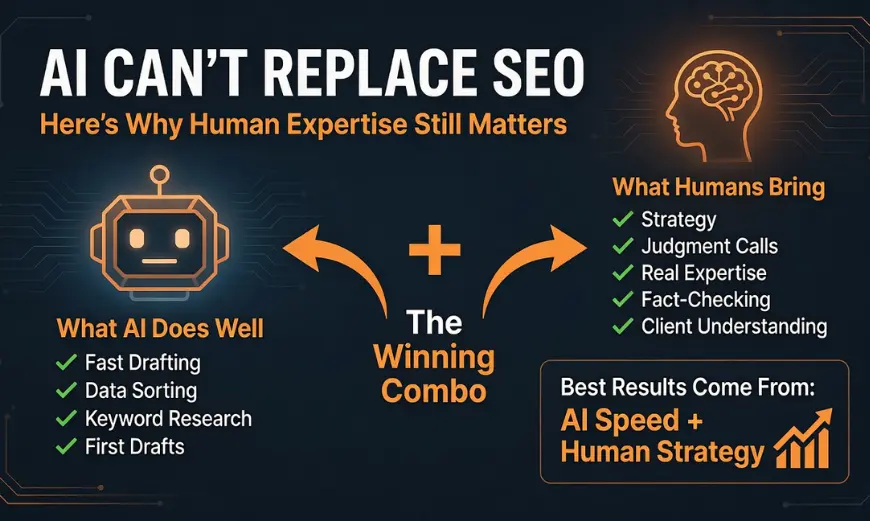
- Getting through the boring parts fast. Pulling apart a competitor’s page structure. Running through a keyword list. Drafting a rough outline so I’m not staring at a blank doc.
- Sorting through data. Nobody wants to spend an afternoon manually sorting a year of analytics. AI is legitimately faster at spotting a pattern worth a second look.
What it doesn’t get to do is the last step.
Every draft that comes out of a tool gets read, edited, and fact-checked. Usually rewritten in parts too, by someone on my team who actually knows the client’s industry, before it goes anywhere near their website.
If you’re trying to figure out whether an agency actually does that step, or just publishes whatever the tool spits out, ask directly. We’ve laid out a few of the right questions in our piece on choosing a real content partner instead of a content mill.
The Real Answer to “Will AI Replace SEO?”
Not this year. Probably not for a while after that either.
The businesses actually seeing results in 2026 aren’t the ones who picked a side between AI and human strategists. They’re the ones using AI for speed, and keeping a person in charge of the judgment calls.
That’s genuinely how we run things at Wowbix. AI gets us through research and first drafts faster than we could five years ago. But the strategy, the fact-checking, and the actual voice of the content still comes from someone on the team who knows the client’s business.
Want to see more of how we think about this day to day? Our blog covers the same questions clients bring us on calls.
Wondering whether your own content is actually built to hold up, or just built to exist? Reach out to our team and we’ll walk through it honestly. No pitch required.
FAQs
Will AI replace humans in SEO?
No, not the way most people picture it. AI can automate the repetitive parts and chew through data fast, but it still can’t set a strategy, read a room, or make a judgment call the way someone with real SEO experience can. Every account I’ve seen actually grow still has a person steering it.
Is it possible for AI to write SEO content entirely on its own?
It can produce a draft in seconds, sure. What it usually can’t do is add the depth or first-hand detail that makes a page actually stand out, which is a big part of what Google’s E-E-A-T guidelines are looking for. Left unedited, most AI drafts read fine but say nothing new.
Why does SEO still need a human strategist?
Because a tool can execute a plan but it can’t build one from scratch around a specific business. Understanding why a customer buys, what your brand actually sounds like, and how a market shifts still takes a person who’s paying attention, not a prompt.
Where does AI actually fall short when it comes to SEO?
Mostly context and diagnosis. AI can flag that a page dropped in rankings, but it won’t tell you whether that’s a core update, a technical issue, or a competitor who just outpaced you, and it can’t reliably pick up on tone, regional nuance, or industry-specific jargon either.
Does AI-generated content satisfy Google’s E-E-A-T standards?
Not fully on its own. E-E-A-T is built around demonstrated, first-hand experience and trust, and that’s something a person has to bring to the page. AI can help structure the research, but the credibility still comes from a human editor checking it over.
What role does AI actually play on a modern SEO team?
It clears out the slow, repetitive work, keyword research, technical audits, reporting, so the actual strategists on a team get more time to focus on decisions that move the needle instead of busywork.
Can you safely publish AI-written content for SEO purposes?
Only once a person has actually gone through it. Raw AI output can carry made-up statistics, generic phrasing, or claims that don’t hold up, and that’s exactly the kind of thing that costs a site trust if it goes live unchecked.
What can a human SEO expert do that AI still can’t?
Diagnose the real reason something broke, write with actual first-hand experience, and make the kind of judgment call that depends on knowing a specific business rather than a general topic.
How should a business balance AI tools with human SEO expertise?
Let AI take the repetitive load, research, data sorting, first drafts, and let a person with real industry knowledge own the strategy, the fact-checking, and the final voice of what gets published.