




You’ve probably heard this before: “SEO is dead.” Or maybe: “Just do SEO, it’s cheap.” Or the personal favorite: “My cousin’s friend does SEO and it worked great.”
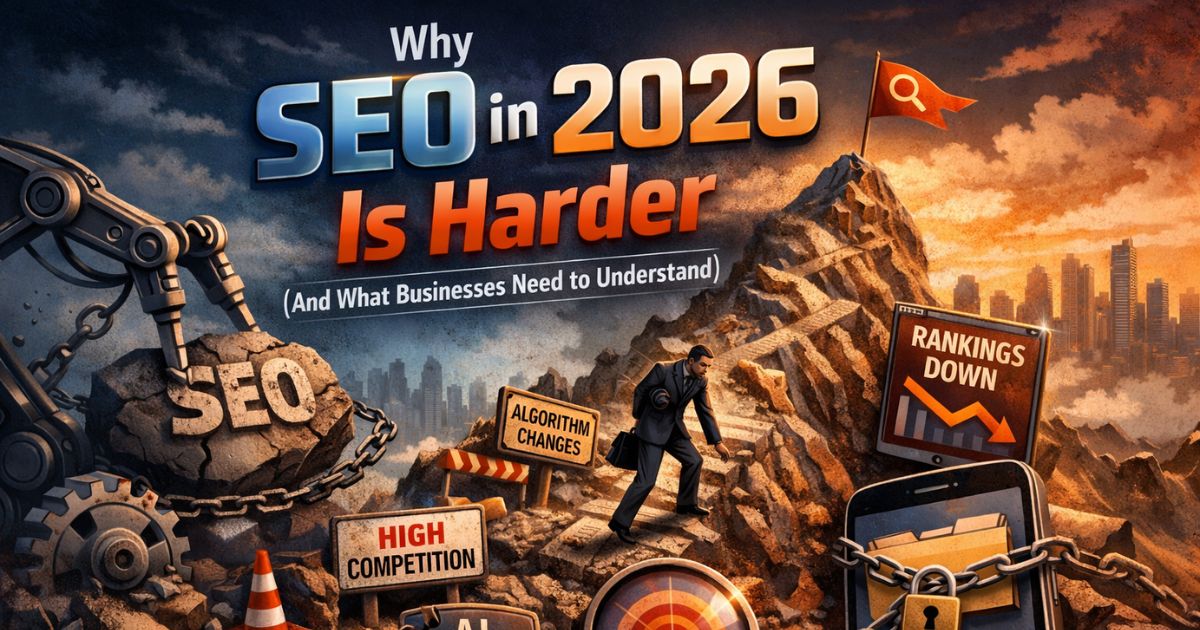
Here’s the truth nobody wants to admit: SEO in 2026 is harder than ever—not because it’s dying, but because cheap SEO is dying.
And that changes everything.
The Real Shift in 2026 SEO
Five years ago, you could hire someone for $500/month, throw some keywords on your homepage, get a few backlinks, and rank. Wasn’t great SEO. Wasn’t sustainable. But it worked.
Not anymore.
Google’s gotten smarter. AI tools demand credibility. Your competitors are finally investing properly. And the businesses winning in 2026 aren’t the ones cutting corners—they’re the ones building real foundations.
Here’s what we’re seeing across our client work:
Cheap SEO is dead. Budget agencies throwing keywords at pages don’t move the needle. Neither do AI-generated content farms or mass link-building schemes. Google’s algorithms demolish these tactics now.
Real SEO is working better than ever. But it requires something most businesses don’t want to hear: thoughtful strategy, quality content, technical foundation, and patience.
The gap between winners and losers has never been wider.
Why SEO Got Harder (The Real Reasons)
1. Google Now Understands Intent, Not Just Keywords
Remember when ranking for “best pizza near me” was about keyword density? Those days are gone.
Google now understands what people actually want. It looks at:
- Search context: Are you a local pizzeria or a national chain?
- User intent: Is the person hungry, or researching pizza recipes?
- Content quality: Is this actually useful or just keyword-stuffed?
- Business legitimacy: Is this a real business or a content farm?
You can’t trick it anymore. That’s why cheap SEO fails. You can’t keyword-stuff your way to the top. You need real content, real expertise, and real business backing.
2. AI Tools Are Raising the Bar for Credibility
ChatGPT, Copilot, and other AI tools are now search competitors. They pick sources based on trustworthiness, not rankings.
If your site looks abandoned, doesn’t have current information, or lacks author expertise, AI tools won’t surface you. Even if you rank on Google.
This is new. Five years ago, you only had to beat Google’s algorithm. Now you have to prove credibility to multiple systems at once.
3. Your Competitors Are Finally Taking SEO Seriously
In 2020, maybe 20% of businesses in your space were actually investing in SEO. Now? It’s more like 70%.
Competition increased. Keyword difficulty increased. The easy wins disappeared.
If you’re still using 2020 SEO tactics, you’re already behind
4. Search Behavior Fragmented
People aren’t just using Google anymore. They’re on TikTok, Reddit, LinkedIn, YouTube, and asking ChatGPT directly.
This means traditional SEO (ranking on Google) is less of a total solution than it used to be. You need visibility across multiple platforms, which requires more resources and strategy.
You can’t just “do SEO” and expect to dominate search. You need a broader visibility strategy.
Why Business Model Actually Matters More Than Keywords
Here’s the part that surprises people: Strong SEO now depends more on your business margins than your keyword difficulty.
Let me explain.
What SEO Actually Requires in 2026
- Quality content — Hiring real writers, researchers, and subject matter experts costs money.
- Technical foundation — Building fast, mobile-friendly, well-structured sites costs money.
- Ongoing optimization — Updating content, fixing issues, monitoring performance costs time and money.
- Patience — Results take 3-6 months minimum. You need enough cash flow to sustain.
- Expertise — Either hiring an experienced agency or a senior in-house person. Both cost significant money.
Now here’s the brutal part: If your business model doesn’t support these investments, SEO won’t save you.
The Math That Matters
Let’s say you sell a service. You get a client for $5,000. Your profit margin is 40%, so you make $2,000.
To rank for your keywords properly, you need to invest $2,000-5,000/month in quality SEO. That’s 1-2.5 clients per month just to break even on the SEO investment.
If you only get 1 new client per month total, SEO destroys your profit margin.
But if you get 8-10 clients per month? That SEO investment becomes the best money you’ve ever spent. One high-ticket client pays for your entire SEO budget.
The business model has to support the investment. If it doesn’t, even the best SEO strategy fails.
Who Wins in 2026 SEO
- High-ticket services (legal, financial, healthcare, premium coaching) — Strong margins support solid SEO investments
- E-commerce with healthy margins — Can afford to invest in content, link building, paid ads
- SaaS and subscription businesses — Customer lifetime value justifies SEO spend
- Local businesses with multiple locations — Can pool resources for better strategies
Who struggles:
- Low-margin e-commerce — Can’t afford quality SEO alongside other marketing
- Service businesses with thin margins — Can’t invest enough to compete
- One-person shows with tight budgets — Can’t sustain the investment long enough to see results
This isn’t about skill. It’s about math. If your business model doesn’t have room for proper SEO investment, it won’t work.
The Foundation Myth (And Why It’s Actually True)
Here’s something we tell every client: “If your foundation isn’t right, traffic won’t save you.”
This sounds abstract. Let me make it concrete.
What’s the Foundation?
The foundation is the unglamorous stuff that doesn’t directly rank you but enables ranking:
- Clear value proposition — Does your website clearly explain what you do and why someone should care?
- Technical health — Is your site fast? Mobile-friendly? Properly structured?
- Business credibility — Do you have real reviews, clear contact info, and signs of being an actual business?
- Content strategy — Do you have a coherent plan for what to write about, or are you just throwing things at the wall?
- User experience — Can visitors actually find what they need, or do they bounce in 10 seconds?
Why It Matters
Let’s say you rank #1 for your keyword. But when people land on your site:
- They can’t tell what you do
- The page is slow and looks ancient
- You have no reviews or trust signals
- They can’t find your pricing or contact info
They leave. Bounce rate spikes. Google notices. Your ranking drops.
Traffic without foundation is useless. You need both.
What SEO Actually Looks Like in 2026
If cheap SEO is dead, what does good SEO look like now?
1. Strategic Content
Not “write 100 blog posts.” But “write 20 really good articles that answer the exact questions your customers are asking.”
Quality over quantity. Research-backed. Expert-written. Updated regularly.
2. Technical Excellence
Your site needs to be fast, mobile-friendly, well-structured, and accessible. This isn’t optional anymore. It’s table stakes.
3. Business Credibility Signals
Reviews, author expertise, clear contact information, active maintenance, current information. These matter more now because Google and AI tools look for them.
4. Link Strategy (That Actually Works)
Not buying links. But earning them through relationships, guest posts, and being genuinely worth linking to.
This takes longer but actually works.
5. Patience
SEO takes 3-6 months minimum to show results. If your business can’t sustain that without ROI, this isn’t for you. And that’s okay.
Who Should Actually Do SEO in 2026?
Be honest with yourself:
Do SEO if:
- Your business model supports 3-6+ months of investment before ROI
- You have profit margins that allow for quality content and strategy
- You’re willing to invest in expertise (not the cheapest option)
- You play long-term (not expecting results in 30 days)
- Your business serves customers who actively search for solutions
Skip SEO if:
- Your business model is tight-margin and requires immediate ROI
- You don’t have the budget for quality content and strategy
- You’re expecting fast results
- Your customers don’t search for solutions online
- You’re hoping a cheap agency can save you
This isn’t pessimism. It’s honesty. Some businesses thrive with SEO. Others don’t. And that’s determined by business model, not by SEO skill.
The Good News
Here’s what we tell clients:
If you have the foundation, SEO in 2026 is more rewarding than ever.
Why? Because cheap competition is gone. The businesses that do invest properly face less noise. Quality content ranks faster. Credibility signals compound over time.
If you build a real foundation—good content, technical excellence, business credibility, strategic thinking—you don’t have to be perfect. You just have to be better than the people cutting corners.
And most of your competitors still are.
What You Should Do Right Now
- Honest assessment: Does your business model support proper SEO investment?
- Foundation audit: Is your website technically sound, credible, and user-friendly?
- Strategy first: Before hiring anyone, define what you want to rank for and why.
- Invest properly: Whether you hire an agency or do it in-house, budget for quality, not cheapness.
- Patience: Expect 3-6 months. If that breaks your business model, SEO isn’t the right channel.
SEO in 2026 isn’t harder because it’s broken. It’s harder because the easy shortcuts are gone. But for businesses with the foundation and resources to invest properly?
It’s never been more rewarding.
Ready to Build Your SEO Foundation?
We work with businesses that are serious about doing SEO right. If you’ve got the foundation and want to invest properly, we can help you build a strategy that actually works.
Learn more about our SEO services for healthcare, service businesses, and e-commerce companies.
The businesses winning aren’t the ones with the biggest budgets. They’re the ones with the smartest strategy and the strongest foundation.
Watch this quick video on this topic: